


Gearboxes for Industrial Robots: Precision, rigidity, and load capacity for all axes
Industrial robots require gearboxes that transmit motion precisely and operate reliably over the long term, even under dynamic loads. Depending on the robot axis, different factors take center stage—from torque and stiffness to size and weight. For over 40 years, we have supported our customers as a development and design partner, delivering high-performance drive solutions for demanding robotics applications. Our portfolio of cycloidal and strain wave gearboxes covers a wide range of torque, installation space, and axis requirements, enabling a precisely tailored design for each specific application. Thanks to our expertise in series production and our reliable large-scale manufacturing processes, even high production volumes can be produced economically and reliably.



Do you need gearboxes for your industrial robot?
We'll find the right solution for your application and support you every step of the way, from design to integration.
Request a Consultation
What advantages do Nabtesco gearboxes offer in industrial robots?
Our gearboxes for industrial robots enable precise, dynamic, and compact robot axes. They cover a torque range from 4.5 to 70,000 Nm and are characterized by high positioning accuracy, torsional rigidity, and high gear ratios. In addition, they offer high shock resistance and overload capacity, as well as a long service life with minimal wear.
Your benefits:
- Precise and repeatable robot movements: Low torsional backlash, hysteresis loss < 1 arcmin, and high positioning accuracy
- High system availability: Durable gearboxes with low wear
- Compact robot axes: High power density with minimal installation space and weight
- Dynamic robot movements: High acceleration capability for fast motion cycles
- Reliable under high loads: High rigidity and resistance to shocks and overloads
- Flexible integration into various robot concepts: Solutions for different axis sizes and performance requirements
Nabtesco is the global market leader in robot gearboxes
Nabtesco holds a global market share of approximately 60% in precision gearboxes for the joints of medium- to large-sized industrial robots, thereby occupying a leading position in the market for robot gearboxes. For many years, we have been collaborating with renowned robot manufacturers to develop gear and drive solutions that meet high standards for precision, dynamics, installation space, and reliability.
Your benefits:
- Long-standing collaboration with robot manufacturers
- In-depth application and development expertise
- Experience in development and series production for robotics

Cycloidal and Strain wave gears from a single source
Nabtesco offers high-precision cycloidal gears and backlash-free strain wave gears from a single source. Cycloidal gears are particularly well-suited for high-load axes and high torques in industrial robots. Strain wave gears demonstrate their strengths in compact, lightweight robot axes and cobot applications with small to medium torques. Having a single point of contact for the entire gearbox portfolio simplifies design processes, shortens development cycles, and enables the implementation of a consistent gearbox strategy with optimally coordinated components.
Comparison of Cycloidal and Strain Wave Gearboxes for Robot Axes
| Characteristic | Cycloidal gears | Strain wave gears |
|---|---|---|
| Torque range | High to very high | Low to medium |
| Angular backlash | Virtually zero backlash | Zero backlash |
| Torsional stiffness | Very high | Medium |
| Torsional stiffness | High to very high | High |
| Load capacity | High to very high | Medium |
| Overload capacity | Very high | High |
| Installation space and weight | Larger and heavier | More compact and lighter |
| Typical application | High-performance, heavy-duty axes | Smaller, more compact robot axes |

What demands do the individual robot axes place on the gearbox?
The requirements for the gearbox vary depending on the robot axis. In the lower axes, the focus is primarily on high torques and loads; as one moves toward the wrist, compact design, low weight, and dynamic movements become increasingly important. Precision and repeatability are crucial throughout.
Example: Typical requirements for a 6-axis industrial robot
| Robot axis | Typical requirements for the gearbox |
|---|---|
| Axis 1 | High torsional stiffness, high load capacity, high load-bearing capacity, provision for cable routing |
| Axis 2 | Very high torque, high torsional and tilting stiffness, high load capacity |
| Axis 3 | High torque, high dynamics, high stiffness under varying loads |
| Axis 4 | High dynamic performance, compact footprint, option for cable routing |
| Axis 5 | Compact design, low weight, high dynamics |
| Axis 6 | Very compact footprint, low weight, high dynamics, tool and media feed-through |
Technologies for the Next Generation of Industrial Robots

Our digital gearboxes integrate sensors directly into the gearbox—without requiring additional installation space. Torque, temperature, and vibration data enable continuous health monitoring and lay the foundation for condition monitoring, predictive maintenance, and increased robot uptime.

An add-on for the robot controller can be used to compensate for gear-specific deviations. This makes it possible to increase robot accuracy by a factor of 9 and achieve point and path accuracies of less than 0.1 mm. As a result, high-precision handling and machining tasks can be performed with the flexibility of an industrial robot.
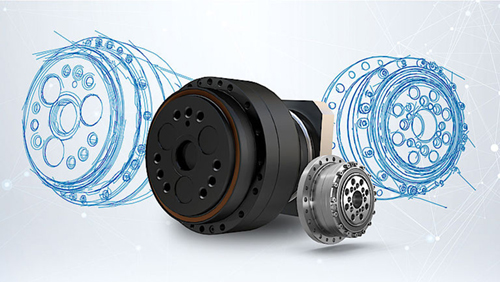
Nabtesco supports robot manufacturers in selecting, designing, and integrating suitable precision gearboxes. Our engineers provide guidance during the early stages of technical coordination, taking into account installation space, interfaces, and application-specific requirements. This enables solutions to be efficiently integrated into a variety of robotics concepts.
Typical Applications for Industrial Robots
Our gearboxes are used in a wide range of industrial robotics applications—from handling and assembly to welding, palletizing, and painting.
Robot Types:
- Welding robots
- Handling robots
- Pick-and-place robots
- Assembly robots
- Palletizing robots
- Painting robots
- Machine-loading robots
- Heavy-duty robots
- Grinding and polishing robots

Why Choose Nabtesco for the Mass Production of Robot Gearboxes?
Nabtesco combines production-ready product design with high modularity, standardized platforms, and scalable manufacturing processes. This enables both standardized and custom-tailored gear solutions to be produced cost-effectively in series.
Your benefits:
- Product design compatible with mass production
- High modularity and standardization
- Custom adaptations based on scalable platforms
- Reliable manufacturing for varying production volumes
- High production capacity of over 1 million gearboxes per year, with plans to expand to 2 million per year by 2030

Our Product Solutions for Industrial Robots

Plug-and-Play
cycloidal gearboxes with solid shafts.
Modular gearboxes with high power density.

Cycloidal Gear Kit
with Solid Shaft
—Compact and Precise: Ideal for Robotics

Cycloidal Gear Kit with Hollow Shaft—
Compact & Precise: Ideal for Robotics

Cycloidal Gear Kit
with Solid Shaft
and Custom Output Bearing

Cycloidal Gearbox Kit
with Solid Shaft
, High Speed, for Tight Spaces

Hollow
Shaft Gear Kit
: The simplest version of the hollow shaft gear

Shaft Gear Kit
with Solid and Hollow
Shafts, Including Output Bearing Assembly

Plug & Play
Shaft Drive with Solid and Hollow
Shafts, Including Input and Output Bearings + Sealing System

Shaft Gear Kit
with Solid and Hollow
Shafts, Including Smart Sensors and Artificial Intelligence

Plug-and-Play
Shaft Drive Systems with Solid and Hollow
Shafts—Complete Systems for Your Automation Needs
Download: White Paper “Gearbox Design for 6-Axis Robots”
Just like humans, robots need flexible “joints” that ideally remain fully functional well into old age. To learn what matters when selecting and designing the right gearboxes and what designers need to keep in mind, read our white paper “Gearbox Design for 6-Axis Robots.”
Download White Paper
FAQ: Frequently Asked Questions About Gearboxes for Industrial Robots
An industrial robot is a robot specifically designed for industrial applications that performs automated motion and processing tasks in production environments. High precision, repeatability, dynamics, and durability are among the key requirements. Typical applications include handling, assembly, welding, palletizing, and painting.
Cycloidal and Strain wave gearboxes are particularly well-suited for industrial robots. The appropriate design depends, among other factors, on torque, rigidity, installation space, weight, and axis position.
Cycloidal gearboxes are particularly rigid, durable, and suitable for high torques. Strain Wave Gear offer the advantages of zero backlash, low weight, and compact dimensions.
Axles subject to heavy loads and high torques are often equipped with cycloidal gearboxes. Strain Wave Gear are often the best choice for smaller, lightweight, and compact axles. The specific design of the respective axle remains the decisive factor.
Robot gearboxes are specifically designed for precise, dynamic, and repeatable movements. Compared to conventional gearboxes, they typically feature low rotational backlash, high torsional and bending stiffness, high gear ratios, a compact design, and high load-carrying capacity. This makes them particularly well-suited for the demanding requirements of robot axes.
Robot gearboxes must be precise, rigid, robust, and durable. Depending on the application, additional requirements regarding dynamics, installation space, weight, and repeatability may also apply.
High rigidity and precision enable accurate and repeatable movements. This is particularly important for high-speed motion sequences, varying loads, and demanding positioning requirements.
When designing a gearbox, factors such as torque, load profile, speed, stiffness, installation space, and desired service life are taken into account. The requirements are evaluated separately for each robot axis.
Digital gearboxes provide operational status and load data for condition monitoring and predictive maintenance. Sensors and data analysis can thus help improve maintenance planning, detect overloads, and increase robot availability.
